
















Build Real-Time Customer 360: Supabase + CRM + ERP Integration
Eliminate data silos across Supabase, HubSpot, NetSuite, and Zendesk with true bidirectional sync. Cut engineering time 90%, enable sub-second updates.
- Author
- Ruben Burdin · Founder & CEO
- Published
- December 13, 2025
- Read time
- 5 min read

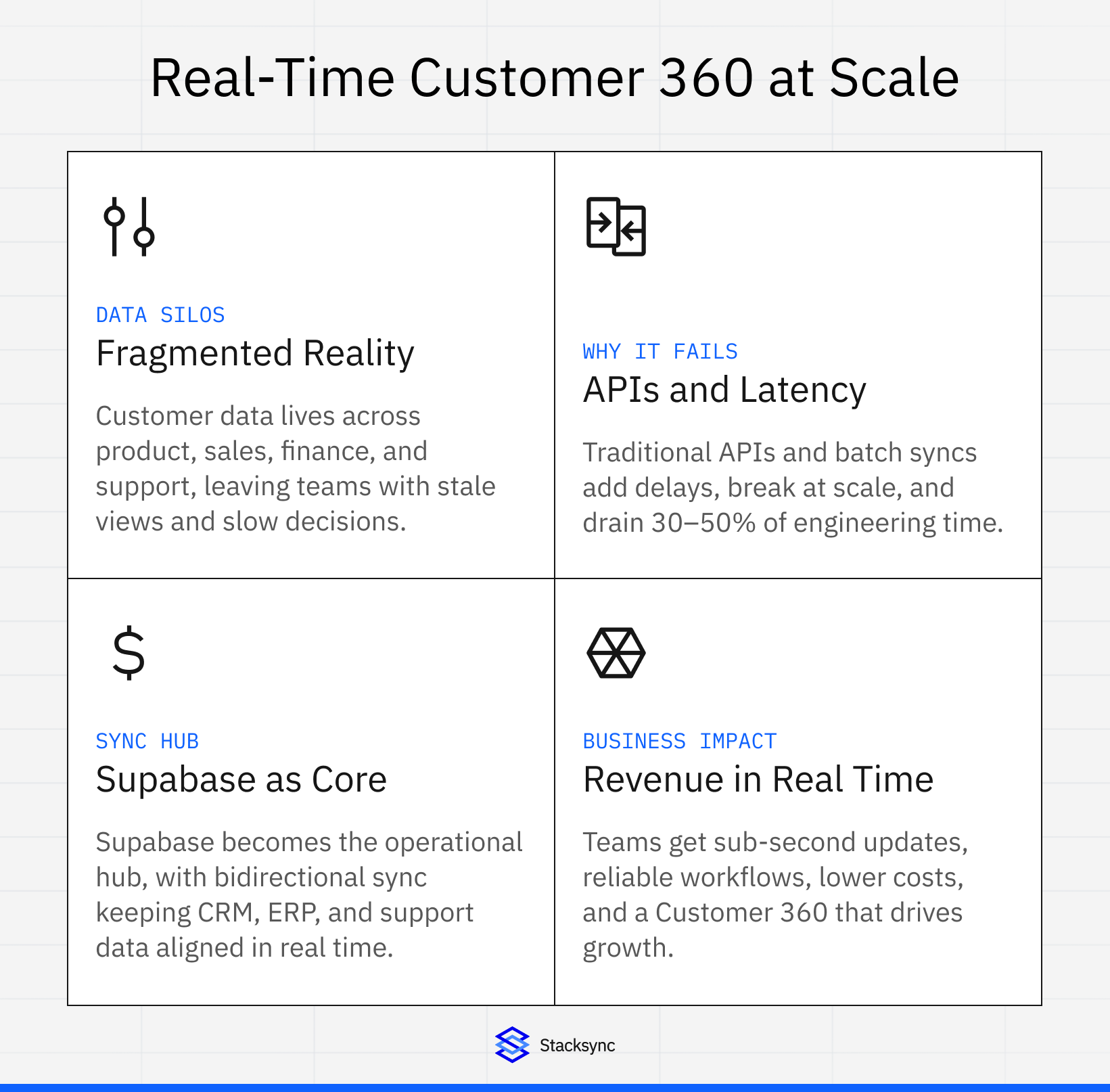
Modern SaaS teams lose 30–50% of engineering time maintaining fragile API integrations instead of building revenue-driving features. A real-time Customer 360 fixes this, but only if data stays synchronized across product, sales, finance, and support systems. This guide shows how enterprises use Supabase as the operational backbone and extend it with bidirectional sync to create a true, production-ready Customer 360.
The Enterprise Data Fragmentation Crisis
Most SaaS companies claim to have a Customer 360, but in practice customer data is fragmented:
- Product usage lives in Supabase
- Sales context lives in HubSpot
- Financial truth lives in NetSuite
- Support signals live in Zendesk
Traditional batch ETL pipelines update this data hours or days later. When a customer’s usage spikes or a support issue escalates, revenue teams are working with stale information. Decisions are made on partial, conflicting data.
At the same time, engineering teams are buried in API maintenance. Rate limits, pagination quirks, schema drift, and retries across multiple systems turn integrations into long-term liabilities.
Why Customer 360 Fails with Traditional Integrations
Customer 360 initiatives usually break for three reasons:
First, API complexity. CRMs and ERPs expose business logic through APIs that were never designed for high-frequency, bidirectional sync. Bulk limits, SOAP/REST inconsistencies, and undocumented edge cases consume engineering time.
Second, latency. Batch-based ETL tools introduce delays that kill real-time use cases like sales triggers, automated renewals, or proactive customer success interventions.
Third, many-to-many integration sprawl. Point-to-point connections grow exponentially as new systems are added, making reliability and change management nearly impossible.
Supabase as the Operational Customer Data Hub
Supabase has become the preferred operational database for modern SaaS teams because it combines PostgreSQL’s reliability with real-time capabilities and a developer-first experience.
Used correctly, Supabase becomes the single operational surface where teams:
- Query customer data with standard SQL
- Power internal tools and dashboards
- Capture product usage events in real time
- Trigger workflows based on live data
But Supabase alone does not solve enterprise fragmentation. Its real power is unlocked when it becomes the hub connecting the rest of the enterprise stack.
The Chained Bidirectional Sync Architecture
A real-time Customer 360 requires chained bidirectional synchronization across multiple systems.
Instead of building direct integrations between every tool, this architecture uses Supabase as an intermediate transformation layer. Each system syncs bidirectionally with Supabase. Changes made anywhere propagate everywhere.
If a record updates in HubSpot, it is reflected in Supabase within milliseconds, then propagated to NetSuite and Zendesk. The same happens when updates originate from product usage or support workflows.
This pattern eliminates many-to-many integration complexity while preserving real-time consistency.
How the Architecture Works in Practice
The architecture relies on four core principles.
First, non-invasive Change Data Capture. Changes are detected without database extensions or custom triggers, preserving platform stability.
Second, SQL-first access. Engineers query CRM, ERP, and support data using SQL instead of API calls, dramatically simplifying logic and testing.
Third, field-level change detection. Systems know exactly which attributes changed, enabling precise workflows and conflict resolution.
Fourth, event-driven automation. Data changes trigger actions such as upsell enrollment, support escalation, or risk alerts the moment thresholds are crossed.
Example Customer 360 Data Model
A common Customer 360 schema in Supabase includes:
- accounts: canonical customer records
- contacts: synced identities across CRM and support
- usage_metrics: real-time product activity
- billing_status: ERP-derived financial state
- support_health: ticket volume and severity
With this model, teams answer questions instantly:
- Which high-usage customers are at payment risk?
- Which support escalations correlate with churn?
- Which accounts qualify for real-time upsell triggers?
Reliability, Failure Modes, and Trust
Enterprise teams care less about happy paths and more about failure scenarios.
In this architecture:
- If NetSuite is temporarily unavailable, changes are queued and retried automatically
- Conflicts are resolved deterministically using configurable rules
- All changes are logged with full audit trails
- Rollbacks prevent partial writes from corrupting downstream systems
This makes Customer 360 safe for revenue-critical workflows.
Security and Compliance Considerations
Customer data crosses sensitive boundaries. A production-ready Customer 360 must support:
- SOC 2, GDPR, HIPAA-aligned data handling
- Encryption in transit with no unnecessary data persistence
- Clear environment separation between development and production
- Role-based access control and auditability
This architecture meets compliance requirements without slowing delivery.

Performance and Scale Benchmarks
Real-world deployments show:
- Sub-second propagation across systems
- Millions of records synced reliably
- Linear scaling without re-architecting
This enables use cases that batch pipelines simply cannot support, such as live sales triggers and instant support routing.
Build vs Buy: Total Cost of Ownership
Building this architecture manually typically requires months of engineering time and ongoing maintenance.
Teams that adopt a managed bidirectional sync layer report:
- 90% reduction in integration maintenance effort
- $30,000+ annual savings versus custom solutions or legacy iPaaS tools
- 5–10× ROI from reclaimed developer time
Customer 360 becomes infrastructure, not a custom engineering project.
Who This Architecture Is For
This approach is ideal for:
- SaaS teams that have outgrown Zapier-style automations
- Engineering leaders optimizing for developer-month ROI
- RevOps teams needing real-time visibility across systems
- Business systems teams managing complex tool stacks
It is not about replacing CRMs or ERPs. It is about making them work together in real time.
Customer 360 as a Competitive Advantage
A real Customer 360 is not a dashboard it is an always-on operational system.
By using Supabase as the backbone and extending it with real-time, bidirectional sync, enterprises turn fragmented customer data into a living system that drives revenue, retention, and customer experience in real time.
FAQ
Frequently asked questions









Related articles