
















Building Production-Ready Internal Tools on Supabase: Enterprise Playbook
How enterprise teams build internal tools 10x faster by combining Supabase’s developer experience with real-time sync, reducing integration maintenance.
- Author
- Ruben Burdin · Founder & CEO
- Published
- December 13, 2025
- Read time
- 4 min read

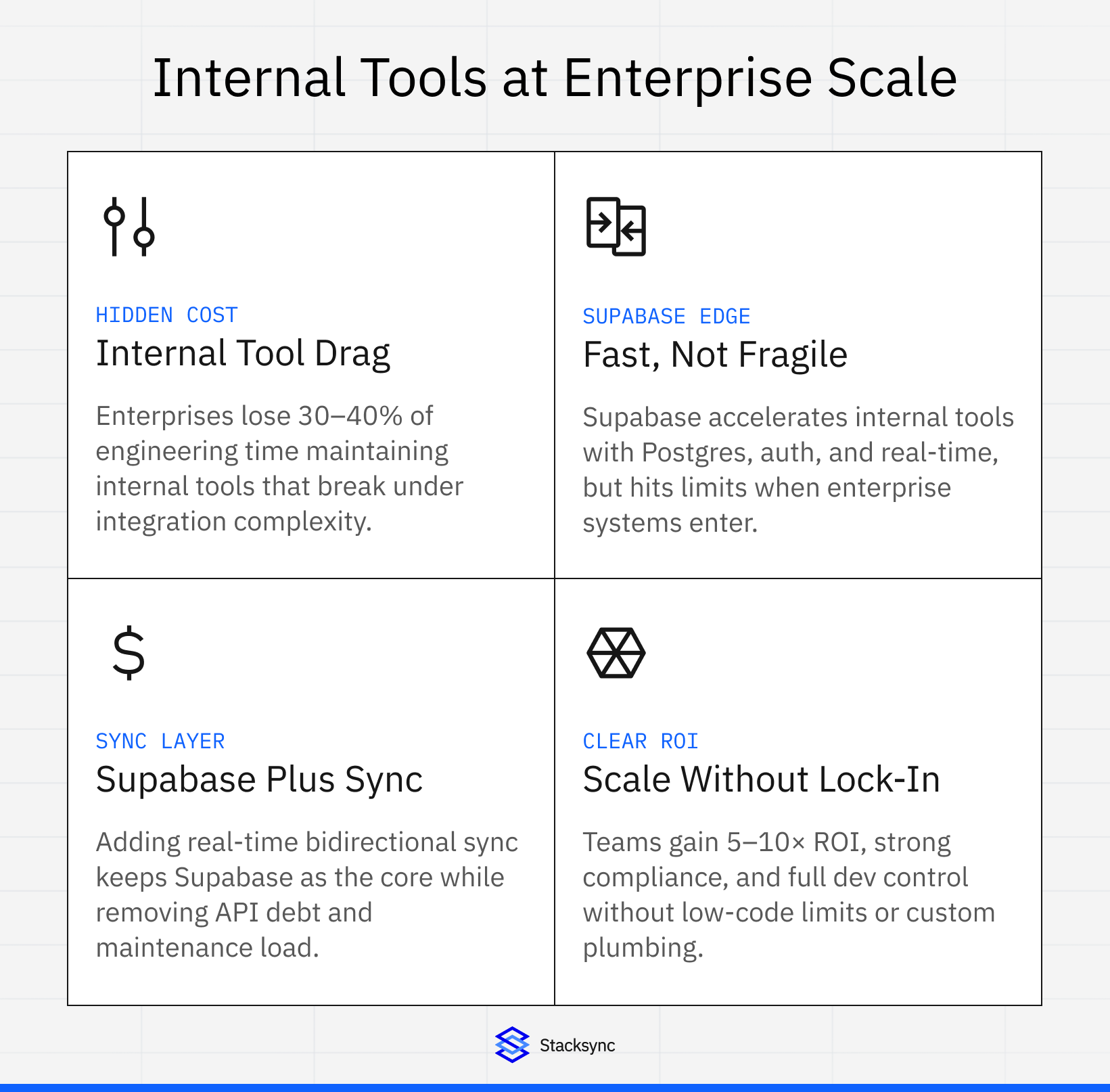
Enterprise teams spend 30-40% of their engineering time building and maintaining internal tools. Supabase changes how fast teams can build, but production-ready internal tools still fail when they hit enterprise integration complexity. This playbook shows how teams combine Supabase with Stacksync to ship scalable, secure internal tools without burning engineering time on brittle API plumbing.
Why Internal Tools Become an Enterprise Bottleneck
Internal tools quietly consume massive budgets. The global internal tools market has reached $250B annually, yet most teams still rebuild dashboards, admin panels, and workflows from scratch or lock into expensive low-code platforms with limited flexibility.
The result is a trade-off no enterprise wants:
- Custom builds that take months and require ongoing maintenance
- Low-code platforms that introduce vendor lock-in and slow teams down at scale
Supabase emerged as a strong alternative by giving teams instant APIs, auth, real-time subscriptions, and storage on top of PostgreSQL. It dramatically reduces time-to-prototype and accelerates internal tool delivery.
Why Supabase Works for Enterprise Teams
Supabase is no longer just an MVP database. With over 1 million managed databases and general availability reached in April 2024, it has proven production readiness across companies like Mozilla, PwC, 1Password, and GitHub.
What makes Supabase attractive for internal tools:
- PostgreSQL at the core, trusted by enterprises globally
- SQL-first workflows that integrate cleanly with CI/CD
- Built-in auth, storage, and real-time capabilities
- Fast iteration without proprietary SDKs
For internal dashboards, admin tools, and operational workflows, Supabase gives teams control without slowing them down.
Where Supabase Alone Hits a Wall
Enterprise internal tools rarely live in isolation. They must integrate with CRMs, ERPs, billing systems, and data warehouses.
This is where most Supabase-based internal tools struggle.
82% of internal tools are built on databases, but connecting them to systems like Salesforce, HubSpot, or NetSuite through APIs becomes fragile fast. Rate limits, schema drift, retries, and edge cases turn simple integrations into long-term maintenance debt.
Engineering teams end up spending 30–50% of their time on integration work instead of shipping product value.
The Supabase + Stacksync Architecture
Stacksync solves the hardest part of internal tools: reliable, real-time integration with enterprise systems.
Instead of treating CRMs and ERPs as external APIs, Stacksync turns Supabase into a bidirectional interface for those systems. Data flows in real time, both ways, without custom sync logic or background jobs.
This architecture delivers:
- Real-time, bidirectional sync between Supabase and enterprise systems
- Sub-second latency for operational workflows
- Minutes to first sync, days to full rollout
- A 90% reduction in integration maintenance time
Supabase remains the system developers work in. Stacksync handles the complexity underneath.
Reference Architecture for Internal Tools
Enterprise teams typically structure this stack as:
- Supabase as the operational database and internal tool backend
- Stacksync as the real-time sync layer
- CRMs, ERPs, and warehouses as connected systems
Changes made in Supabase instantly update Salesforce or NetSuite. Updates from sales or finance teams flow back into Supabase without polling or batch jobs.
This pattern supports:
- Admin panels that write directly to CRM records
- Real-time dashboards across multiple systems
- Operational workflows triggered by live data changes
Developer Experience Without Compromise
Unlike low-code platforms, this approach keeps developers in control.
Teams work with:
- SQL instead of proprietary SDKs
- Version-controlled schemas and migrations
- Existing CI/CD pipelines
- Familiar Postgres tooling
The integration layer becomes invisible. Developers focus on business logic, not plumbing.
Security and Compliance by Design
Enterprise internal tools must meet strict security requirements.
This architecture supports:
- SOC 2, GDPR, HIPAA, and ISO-aligned workflows
- Encrypted data in transit with no persistent storage in the sync layer
- Role-based access control and auditability
- Clear separation between dev, staging, and production environments
Compliance is maintained without slowing down delivery.

Total Cost of Ownership: A Clear Advantage
Compared to alternatives, the Supabase + Stacksync approach delivers strong ROI.
- Custom-built integrations: months of engineering time plus ongoing maintenance
- Low-code platforms: high per-seat costs and limited extensibility
- Traditional iPaaS tools: long implementations and operational overhead
Teams using this architecture report 5–10× ROI through productivity gains alone, before factoring in faster time-to-market.
When This Approach Makes Sense
This playbook is ideal for teams that:
- Need production-grade internal tools, not prototypes
- Want developer control without vendor lock-in
- Must integrate deeply with CRMs, ERPs, and data warehouses
- Are tired of maintaining fragile API integrations
It is not about replacing low-code tools—it complements them for teams who need flexibility and scale.
Building Internal Tools That Scale
Supabase unlocked speed for internal tool development. Stacksyncunlocks scale.
Together, they give enterprise teams a way to build production-ready internal tools that move fast, stay reliable, and integrate cleanly with the systems the business already depends on.
For teams investing in internal tools as a competitive advantage, this architecture provides a clear path forward.
FAQ
Frequently asked questions









Related articles